

Table of Contents
- Why High Protein Waffles Work for Weight Loss
- The Base Protein Waffle Recipe (With Full Nutrition Info)
- Cottage Cheese Waffles: The Highest-Protein Option
- Protein Waffles Without Protein Powder
- Low-Calorie Waffle Toppings That Still Taste Good
- Comparing the Recipes: Calories, Protein, and Fiber Side by Side
- Meal Prep, Freezing, and Reheating Without Soggy Waffles
- Conclusion
- Frequently Asked Questions
Last Updated: October 17, 2026
Why High Protein Waffles Work for Weight Loss
High protein waffles for weight loss work because protein keeps you full longer than carbs alone. A waffle built on eggs, Greek yogurt, or protein powder turns a treat into a real meal. That changes how the rest of your morning goes.
At Six Pack Gourmet Bakery, we build waffles around that exact idea. Protein first, carbs second, taste always. The goal is a breakfast that holds you until lunch without a mid-morning snack.
Here is the honest part most guides skip: protein alone does not cause weight loss. Calories still matter. But protein makes a calorie deficit easier to live with, because you feel full instead of deprived.
How Much Protein You Actually Need at Breakfast
Aim for 20 to 30 grams of protein at breakfast. That range fits most adults who want to feel full until lunch.
The Dietary Guidelines for Americans treat protein as a core part of a healthy eating pattern. Many nutrition coaches split daily protein across meals rather than loading it all at dinner.
So a waffle with 25 grams of protein does real work. A waffle with 5 grams is just a snack pretending to be breakfast.
The Base Protein Waffle Recipe (With Full Nutrition Info)
This is our go-to protein waffle recipe. It makes one large waffle or two smaller ones.
Ingredients:
- 1 scoop vanilla or unflavored protein powder
- 1 large egg
- 1/4 cup rolled oats
- 1/4 cup Greek yogurt
- 1/2 teaspoon baking powder
- 1/4 cup milk of choice
- Pinch of salt
Nutrition per serving (one full waffle): about 300 calories, 28g protein, 22g carbs, 9g fat, 3g fiber.
Those numbers shift with your protein powder and milk. Check your labels and log the real figures if you track macros.
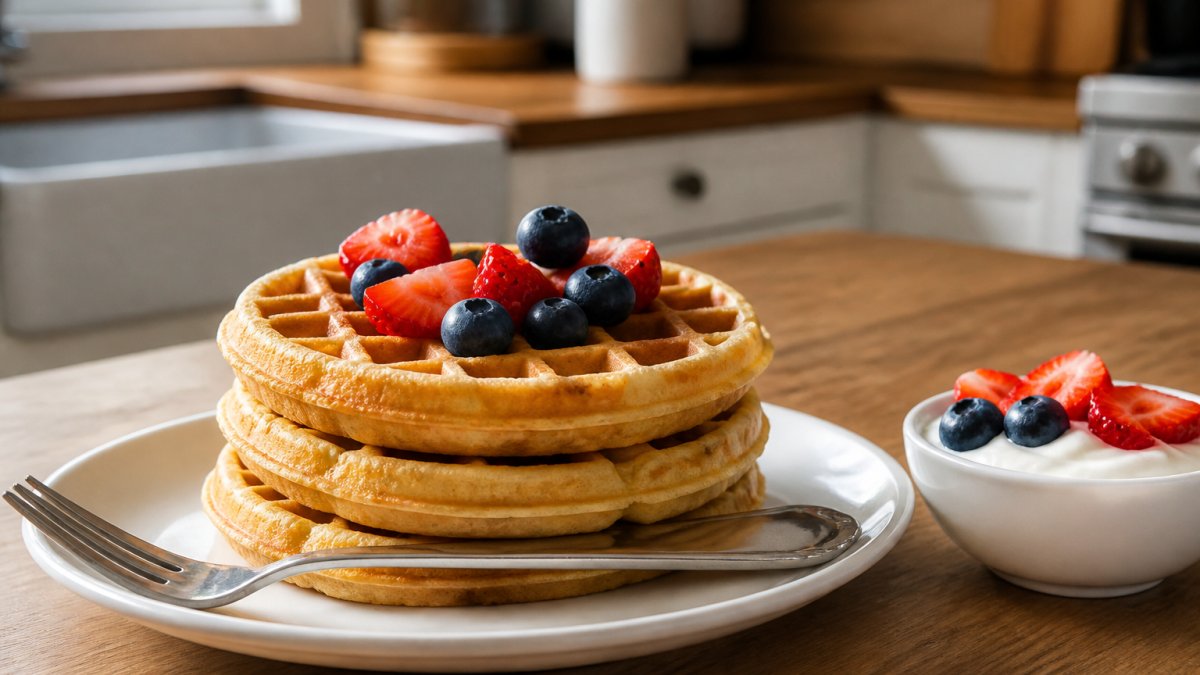
Mixing, Waffle Iron Temperature, and Cooking Time
Blend the oats first until they look like flour. Then add everything else and blend until smooth. Let the batter rest for 5 minutes so it thickens.
Heat your waffle iron to medium-high, around 375°F. Cook for 4 to 6 minutes, until steam slows and the lid lifts easily. A common mistake is opening early. That tears the waffle and leaves it pale.
Cottage Cheese Waffles: The Highest-Protein Option
Cottage cheese waffles push protein higher than any powder-based version. Blend 1/2 cup cottage cheese with 2 eggs, 1/2 cup oats, and a pinch of salt. That is it.
Why it wins: cottage cheese adds protein without a chalky aftertaste. The curds blend smooth, and the result tastes closer to a real waffle than most protein recipes.
Expect roughly 30 to 34 grams of protein per batch, depending on your cottage cheese. Use full-fat for better texture, or low-fat to trim calories.
One drawback: cottage cheese waffles brown faster. Drop your iron to medium and check at 4 minutes.
Protein Waffles Without Protein Powder
You do not need powder to make protein waffles. Eggs, Greek yogurt, oats, and cottage cheese carry plenty of protein on their own.
Try this no-powder version:
- 2 eggs
- 1/2 cup Greek yogurt
- 1/2 cup oats, blended
- 1/2 teaspoon baking powder
- Cinnamon to taste
That lands near 24 grams of protein. The texture comes out softer than powder versions, closer to a pancake. We like it better for kids and picky eaters.
Plant-based eaters can swap in soy-free options. If you avoid dairy, use a plant-based yogurt and add a spoon of nut-free seed butter for body.
Low-Calorie Waffle Toppings That Still Taste Good
Toppings are where a 300-calorie waffle quietly becomes a 600-calorie breakfast. The fix is not to eat a plain waffle, it is to build a plate where every topping earns its calories by adding protein, fiber, or volume. Here is how to do that with measured amounts instead of eyeballing.
The 100-Calorie Topping Budget
Most adults targeting weight loss can afford roughly 100 to 150 calories of toppings on top of a 300-calorie waffle and still land in a breakfast range of about 400 to 450 calories. That is a workable frame, not a rule. Use it to compare swaps.
| Topping | Portion | Approx. Calories | Protein | Fiber | Role on the plate |
|---|---|---|---|---|---|
| Fresh berries | 1/2 cup | 30-40 | <1g | 2-3g | Volume and sweetness |
| Plain Greek yogurt | 1/4 cup | 35-50 | 5-7g | 0g | Creamy protein |
| Sugar-free syrup | 2 tbsp | 10-20 | 0g | 0g | Syrup flavor, low cost |
| Almond butter | 1 tbsp | 95-100 | 3-4g | 1-2g | Fat and satiety |
| Sliced apple + cinnamon | 1/2 apple | 30-40 | 0g | 1-2g | Warm flavor, no added sugar |
| Whipped cottage cheese | 1/4 cup | 45-60 | 6-7g | 0g | High-protein spread |
| Chopped nuts | 1 tbsp | 45-55 | 1-2g | <1g | Crunch, measured |
Read the table as a budget. Berries plus Greek yogurt plus cinnamon lands near 90 calories and adds 6 to 8 grams of protein and 3 grams of fiber. That is a strong default. Nut butter is fine, but one tablespoon is the whole line item, two tablespoons doubles the topping cost before you notice.
Three Topping Stacks With the Math Done
Stack 1, High-protein, low-calorie (about 90 calories added): 1/2 cup berries, 1/4 cup plain Greek yogurt, cinnamon. Total breakfast lands near 390 calories and about 34 grams of protein. This is the stack to default to on a calorie deficit.
Stack 2, Satiety-focused (about 140 calories added): 1 tablespoon almond butter, 1/2 banana sliced, pinch of salt. Total breakfast near 440 calories, about 31 grams of protein, and more fat and fiber to slow digestion. Better on days when lunch runs late.
Stack 3, Dessert-style without the sugar spike (about 60 calories added): 2 tablespoons sugar-free syrup, 1/4 cup whipped cottage cheese, a dusting of cocoa powder. Total breakfast near 360 calories and about 34 grams of protein. This is the swap that keeps a sweet tooth from turning into a mid-morning pastry.
Topping Mistakes That Add Up Fast
- Treating fruit as free. A full bowl of mixed fruit can add 100 to 150 calories. Measure once, then eyeball from there.
- Pouring syrup instead of measuring it. A casual pour of regular maple syrup is often 2 to 4 tablespoons, or 100 to 200 calories of mostly added sugar. Use a measuring spoon for the first two weeks.
- Doubling nut butter. One tablespoon is about 95 to 100 calories. Two is a snack's worth of calories on top of a meal.
- Skipping protein on top. A topping that adds protein (Greek yogurt, whipped cottage cheese) does more for fullness than one that adds only sugar or fat.
A common pattern among people who stick with protein waffles is that they pick one default stack and rotate two others. Decision fatigue is a bigger threat to consistency than any single topping.
Comparing the Recipes: Calories, Protein, and Fiber Side by Side
A comparison table is only useful if it answers a question. The question here is: which of these three waffles should you make, given your calorie target, your protein goal, and how you actually eat breakfast? The numbers below are estimates for one serving, and they move with your protein powder, milk, and cottage cheese labels, so treat them as a starting point and log your own figures if you track macros.
| Recipe | Calories | Protein | Carbs | Fiber | Fat | Serving | Protein per 100 cal |
|---|---|---|---|---|---|---|---|
| Base powder waffle | ~300 | ~28g | ~22g | ~3g | ~9g | 1 large waffle | ~9g |
| Cottage cheese waffle | ~320 | ~32g | ~24g | ~3g | ~10g | 1/2 batch (2 small waffles) | ~10g |
| No-powder waffle | ~290 | ~24g | ~26g | ~4g | ~9g | 1/2 batch (2 small waffles) | ~8g |
How to Read the Table for Weight Loss
Protein per 100 calories is the column that matters most when calories are tight. The cottage cheese version leads at roughly 10 grams per 100 calories, the base powder version sits near 9, and the no-powder version is close behind at about 8. The spread is smaller than most people expect, which means the "highest protein" label is less important than which recipe you will actually repeat.
Fiber is the quiet differentiator. The no-powder version edges ahead because whole oats and Greek yogurt carry more fiber per serving than a scoop of protein powder typically does. Fiber plus protein is the combination most associated with feeling full, so if satiety is your main problem, the no-powder version is a reasonable pick even though it has less protein.
Carbs cluster between 22 and 26 grams per serving. None of these recipes is low-carb in a strict sense, and that is fine for most weight-loss plans, the goal is a balanced plate, not carbohydrate elimination. If you are specifically cutting carbs, reduce the oats and add an extra egg, then re-check the numbers.
Serving size is the trap. The base recipe makes one large waffle; the other two make a batch that splits into two smaller waffles. If you eat the whole cottage cheese batch, you are eating roughly 640 calories and 64 grams of protein, not 320 and 32. Portion the batter before you cook, not after.
A Simple Decision Framework
- Choose the base powder waffle if you want the most adaptable recipe and you already keep protein powder on hand. It is the easiest to scale up or down and the easiest to flavor.
- Choose the cottage cheese waffle if your top priority is protein per calorie and you do not mind watching the iron closely, it browns faster.
- Choose the no-powder waffle if you want whole-food ingredients, more fiber, or a softer texture that kids and picky eaters will accept.
What the Comparison Does Not Tell You
Calories and macros are not the whole story. Texture, cooking time, and how the waffle reheats all affect whether you keep making it. A recipe that wins on paper but turns gummy in the freezer loses in practice. The next section covers freezing and reheating, which is where most of these recipes either earn a permanent spot in your rotation or get abandoned.
One more caveat: these figures assume standard ingredients. A full-fat cottage cheese, a sweetened protein powder, or a higher-calorie milk can each add 30 to 60 calories per serving. Check your labels once, write the real numbers on the recipe, and stop re-doing the math every week.
Meal Prep, Freezing, and Reheating Without Soggy Waffles
Cook a full batch on Sunday and freeze the rest. Cooling on a wire rack first is the key step. Skip it and trapped steam turns your waffles soft.
Freezer steps:
- Cool waffles completely on a wire rack.
- Freeze flat on a sheet pan for one hour.
- Stack in a freezer bag with parchment between them.
- Reheat in a toaster or oven at 350°F until crisp.
They hold for about two months in the freezer. A toaster beats a microwave every time. The microwave steams them and brings back that soggy problem.
Conclusion
Building a breakfast you will repeat is the real challenge. Most people quit because the food is bland or the prep is slow. Six Pack Gourmet Bakery solves both with waffles that are high in protein, low in carbs, and keto-friendly, made from all-natural, non-GMO ingredients. They come in soy-free and dairy-free options, and every box is backed by a 100% satisfaction guarantee.
Get started with Six Pack Gourmet Bakery and make your next breakfast the easy part of your day.
Frequently Asked Questions
Are protein waffles good for weight loss?
They can be, mainly because protein keeps you full longer than a plain flour waffle. A waffle built on eggs, Greek yogurt, or cottage cheese lands around 15-25 grams of protein per serving, which is enough to blunt mid-morning hunger. The catch is calories: nut butter, syrup, and chocolate chips can push a 300-calorie waffle past 600. Keep toppings measured and pair the waffle with fruit or yogurt, and protein waffles fit a weight-loss plan fine.
How much protein should a serving of waffles have?
Aim for at least 15 grams per serving, and 20 or more if the waffle is your whole breakfast. General guidance for adults puts protein needs around 0.7-1 gram per pound of body weight per day for active people, so a 20-gram waffle covers a solid chunk of a 150-pound person's daily target. Check the label or your recipe math: a waffle with 8 grams of protein is a snack, not a meal.
Can you make protein waffles without eggs?
Yes. Use a flax egg (1 tablespoon ground flax plus 3 tablespoons water, rested 5 minutes) or a commercial egg replacer, and add 2 tablespoons of extra Greek-style plant yogurt to keep the batter from drying out. Expect a slightly denser waffle. Cook them a touch longer than an egg-based batch, since the batter holds more moisture and needs the extra time to set in the iron.
What are the best low-calorie toppings for protein waffles?
Greek yogurt thinned with a splash of milk and cinnamon adds roughly 20-40 calories per two tablespoons and a few grams of protein. Fresh berries run about 25 calories per quarter cup. Sugar-free syrup saves 100-plus calories over the regular pour. Skip nut butter by the heaping spoonful: a level tablespoon is around 95 calories, so measure it rather than drizzle it.